
Automated checks This plan went on the timetable after its content and sources passed the studio's automated checks on Sunday 25 October 2026. Before you start
From the studio's plan file
- Plan credited to
- UniPilates, with no writer named
- What backs it
- 6 sources in the reading list
Running order
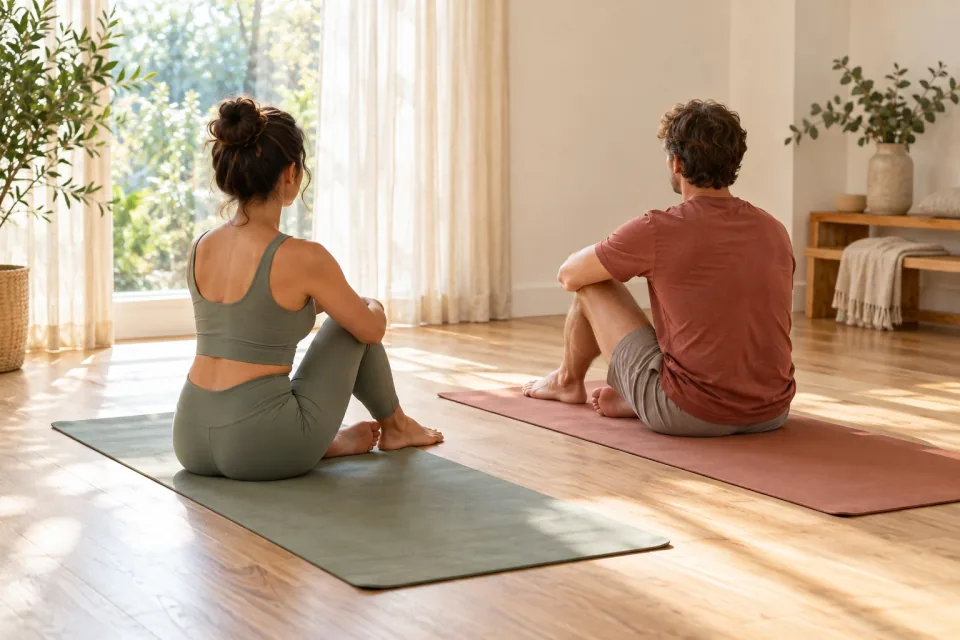
Set 1 of 6
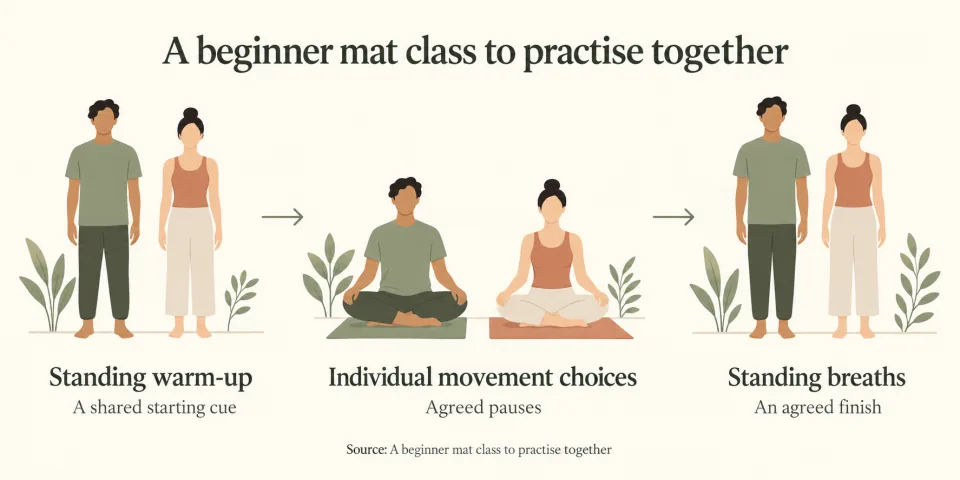
Standing warm-up and a shared starting cue
- 01
- Practise this beginner Pilates class alongside a partner, following the same exercise order while choosing your own pace. Use the sequence and shared pauses below as a suggested class arrangement.
- 02
- Begin standing with your weight spread evenly between your feet. Leave your knees unlocked, following the starting position in the American Lung Association's basic mat class.
- 03
- Let your arms rest beside you while you settle into that position. Give your partner time to find their starting stance before announcing the opening movement.
- 04
- Inhale as you raise your arms. Let the movement follow your own inhalation, even if your partner's arms travel at a different speed.
- 05
- Exhale as your arms come down. Finish the lowering movement before looking across to see whether your partner has finished theirs.
- 06
- Agree who will name the next exercise. For this class, give that person the job of announcing transitions while each participant manages their own movements and counting.
- 07
- Choose a spoken readiness cue, such as ready. Use it after settling into the next starting position, with the transition caller waiting for a reply before announcing the movement.
- 08
- Choose a separate pause cue. Use pause when you want more time to read an instruction, change position or rest, then return to the readiness exchange when you want to continue.
- 09
- Keep counting private during the exercises. Say the exercise name and transition cues aloud, leaving each participant free to follow their own breathing rhythm between those shared announcements.
- 10
- If you use a video alongside these written cues, agree who will operate it. Pause playback during a position change and resume after the readiness exchange, rather than using the video's next movement as the signal to hurry.
- 11
- Make rest an available choice throughout the class. The American Lung Association's basic mat class allows participants to rest when an exercise does not suit them.
- 12
- Finish the standing warm-up with your arms beside you. Announce Pelvic Curl, then take your place lying face up and wait until your partner has reached the same starting position.
Set 2 of 6
A gradual curl from the mat
- 13
- Begin Pelvic Curl lying face up, with your knees bent and your feet about hip-width apart. Place your arms beside your body and let your neck and shoulders relax.
- 14
- Settle your pelvis into its neutral starting position. Take time over this setup before giving the readiness cue, even if your partner is already waiting.
- 15
- Exhale and draw your abdomen inward as you begin lifting your pelvis. Continue the lift progressively through your back, following the movement described in NC State University's Pelvic Curl instructions.
- 16
- Keep the lift gradual as you move away from the mat. Attend to your own sequence rather than using the height of your partner's pelvis as the point to reach.
- 17
- Inhale at the top, where your shoulders, pelvis and knees form a straight line. Keep your attention on that alignment while your partner follows their own breath.
- 18
- Exhale as you lower your spine gradually to the mat. Finish the return before beginning another lift, allowing the downward movement its own complete breath.
- 19
- Count a repetition after you have returned to the starting position. Use that same counting point throughout the set so that a pause at the top does not become an extra count.
- 20
- NC State University specifies ten repetitions for Pelvic Curl. Use that published count as a reference for the exercise, with each participant choosing when to finish or take the available rest.
- 21
- If your movements finish before your partner's, remain lying face up with your feet down. Leave the next exercise unannounced while your partner completes the movement they are doing.
- 22
- If you are still moving when your partner settles, continue your own gradual return to the mat. Let their resting position mean that they are waiting, rather than taking it as a cue to speed up.
- 23
- Use a shared pause after the final lowering movement. During that pause, check the next starting position in the written instructions instead of adding extra curls to fill the interval.
- 24
- Announce Knee Fold while you are still lying face up. Keep your feet on the mat as you prepare, and exchange the readiness cue before either participant begins lifting a leg.
Set 3 of 6
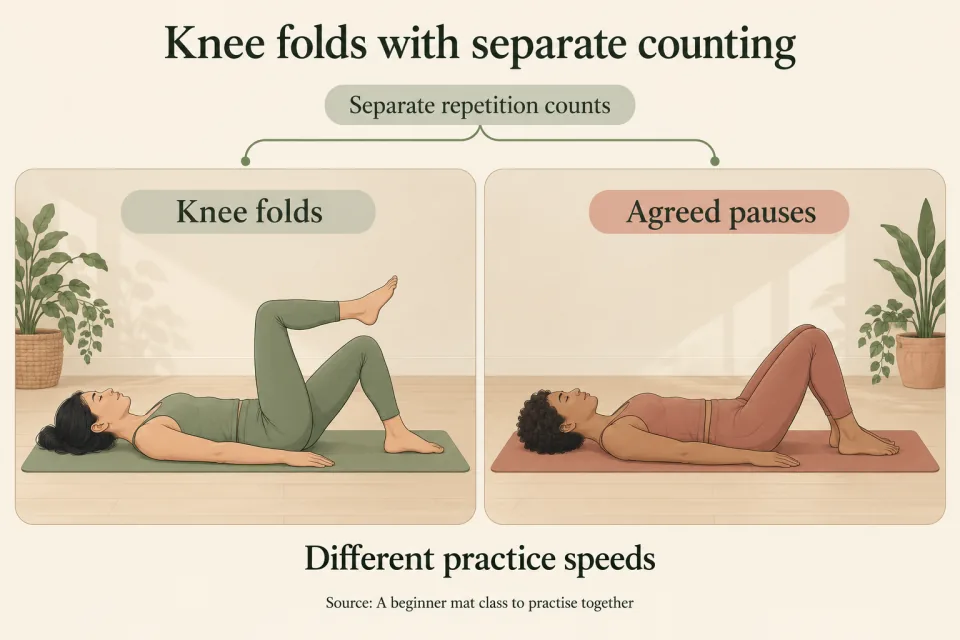
Knee folds with separate counting
- 25
- Set up Knee Fold lying face up, with your arms beside you and your palms down. Place your feet hip-width apart and bend your knees to approximately a right angle.
- 26
- Choose which leg you will move first and say which side you have chosen. You may start on matching sides for an easier spoken cue, while keeping the repetitions and breathing separate.
- 27
- Exhale as you lift the chosen knee above its hip. Preserve the bend at the knee as the leg rises, rather than changing its shape during the lift.
- 28
- Inhale as you lower the leg until the toes meet the mat. Keep the knee angle unchanged through the return, then count the completed movement to yourself.
- 29
- Keep your pelvis still while the leg moves. The supine marching in the American Lung Association's basic mat class uses this same emphasis, without deliberately arching or flattening the lower back.
- 30
- Bring your attention back to the lowering phase if you begin following your partner's rhythm. Let the toes reach the mat on your own inhalation before beginning the next lift.
- 31
- NC State University gives five Knee Fold repetitions on a leg before changing sides. After your chosen repetitions, place that foot fully down before preparing the other leg.
- 32
- Use the side change as a shared meeting point for this set. The participant who finishes first places the foot down and rests while the other finishes their current sequence.
- 33
- For example, let the waiting participant announce that their foot is down while their partner is still lowering a leg. The moving participant completes the return, places the foot down and answers ready when prepared to change sides.
- 34
- Begin the other side after that exchange. The common starting cue marks the transition; each participant then resumes their own count and breath timing.
- 35
- If you choose to rest during this side, place the moving foot down and leave it there. Rejoin at the next exercise announcement instead of trying to reconstruct your partner's count.
- 36
- Finish with your feet resting on the mat. Announce Ab Prep, then take time to arrange your hands and head before exchanging the next readiness cue.
Set 4 of 6
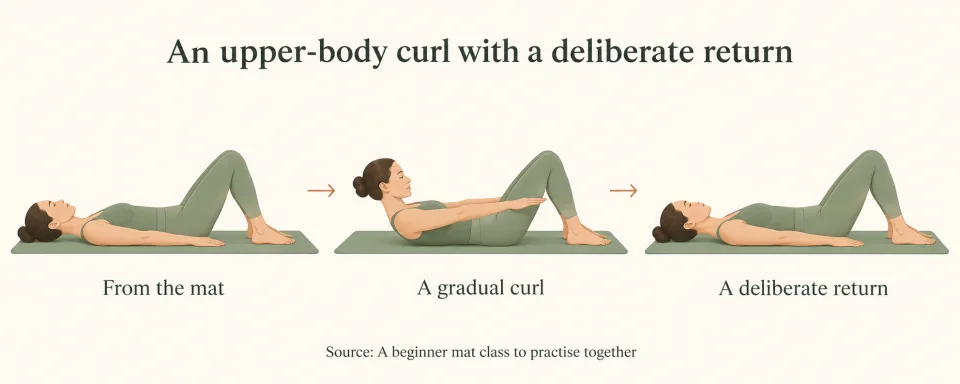
An upper-body curl with a deliberate return
- 37
- Begin Ab Prep lying face up with your knees bent and your feet resting on the mat. Interlace your fingers behind your head and let your elbows point outward.
- 38
- Angle your chin slightly towards your chest before starting the curl. Make this preparation while your head is still down, then give the readiness cue once your hands and feet are arranged.
- 39
- Exhale as you curl your head and upper trunk upward. In NC State University's description, the shoulder blades leave the mat and the back of the waist comes into contact with it.
- 40
- Follow your own upward movement without trying to reach your partner's position at the same instant. Healthline advises giving movement quality priority over the number of repetitions.
- 41
- Inhale during the pause at the top of the curl. Keep this breath within your own movement sequence, even if your partner has already begun returning to the mat.
- 42
- Exhale while lowering your upper trunk and head. Complete the return before counting the repetition, using the same counting convention you used for Pelvic Curl.
- 43
- NC State University specifies ten repetitions for Ab Prep. Keep that source count separate from your partner's progress, and use the resting option whenever you choose to end your sequence.
- 44
- During the return, attend to the movement you are completing rather than anticipating the next lift. Let the exhalation accompany the lowering phase all the way back to the starting position.
- 45
- If you lose your place in the count, settle back onto the mat and pause. Leave the count unresolved rather than asking your partner to supply theirs, since their total belongs to their own sequence.
- 46
- For a shared practice example, let a participant who has finished rest with their head down while the other continues. The waiting participant can name Breast Stroke Prep after the moving participant has also returned to the mat.
- 47
- Take the position change separately from the exercise itself. Read the face-down setup while resting, then turn into that position at your own pace.
- 48
- Wait until your partner has finished arranging their arms and legs before giving the next movement cue. Use the readiness exchange to mark the end of the transition, leaving the following breath free for the exercise.
Set 5 of 6
A face-down lift at your own pace
- 49
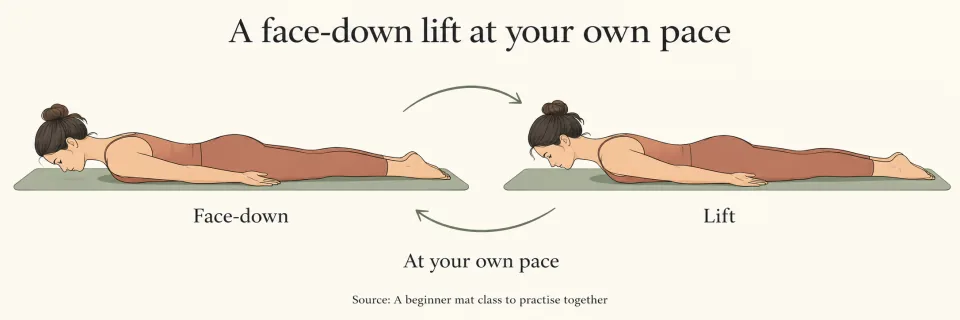
- Begin Breast Stroke Prep face down with your forehead resting on the mat. Keep your legs together and your arms straight beside your thighs.
- 50
- Settle your arms against your thighs before starting. Give your partner time to finish the same setup, then exchange the readiness cue without lifting early.
- 51
- Exhale as you raise your head and upper and middle trunk. Keep your arms against your thighs throughout the upward movement, following NC State University's description.
- 52
- Choose your own movement size while keeping that arm position. Healthline notes that beginners may need smaller movements as they learn the exercises.
- 53
- Inhale as you lower your head and trunk slowly towards the mat. Let the return finish before you begin preparing another lift.
- 54
- Count after the lowering movement is complete. Keep the count to yourself so that your partner can follow a different rhythm without hearing a running total to match.
- 55
- NC State University specifies ten repetitions for Breast Stroke Prep. Use the count as a source example while leaving the decision to continue or rest with each participant.
- 56
- Keep the inhale and lowering movement together when your partner finishes before you. Complete the movement already underway before responding to a transition announcement.
- 57
- If you finish first, return your forehead to the mat and rest. Give the other participant the remaining space in the set without filling it with extra lifts or repeated readiness questions.
- 58
- If you want to check an instruction, call pause after returning to the mat. Read the relevant movement cue, then decide independently whether to resume this exercise or wait for the standing close.
- 59
- Announce the standing close after you have each finished moving. Take time to leave the face-down position and come to standing, treating the change of position as its own part of the class.
- 60
- Wait in your standing position until your partner is also ready. Begin the closing movement only after the readiness exchange, rather than letting the participant who stands first set the pace.
Set 6 of 6
Standing breaths and an agreed finish
- 61
- Close standing with your weight evenly distributed between your feet and your knees unlocked. Let your arms rest beside you while you settle after the move from the mat.
- 62
- Begin with easy breathing. Give yourself time to arrive in the standing position before adding the arm movement used at the end of the American Lung Association's basic mat class.
- 63
- Inhale as you raise your arms. Follow the length of your own breath, letting your partner's movement take place alongside yours without trying to match it.
- 64
- Exhale as your arms lower. Allow them to return to your sides before deciding whether to continue with another arm movement or finish standing quietly.
- 65
- If your partner continues after you finish, leave your arms at your sides and breathe as usual. Use this resting stance as the waiting position for the close.
- 66
- If you are still moving, finish the lowering phase at your own pace. Answer the closing cue after your arms have returned to your sides, so the shared finish follows the movement rather than interrupting it.
- 67
- Agree that the class ends after each participant has completed their chosen closing movement. The transition caller can announce finished once the other participant has settled, without adding a final repetition for the sake of matching.
- 68
- Before leaving your place, name a transition you would like to arrange differently next time. Keep the request practical, such as pausing playback earlier or announcing the next starting position before anyone moves.
- 69
- Choose who will call transitions at the next practice. Keep that role separate from deciding how many repetitions the other participant performs or how quickly they move through them.
- 70
- Carry the same readiness exchange into your next shared class. Name the exercise, settle into its starting position and wait for the reply before beginning, then leave the movement and breathing pace to each participant.