
Automated checks This plan went on the timetable after its content and sources passed the studio's automated checks on Tuesday 27 October 2026. Before you start
From the studio's plan file
- Plan credited to
- UniPilates, with no writer named
- What backs it
- 10 sources in the reading list
Running order
Set 1 of 6
Warm up and choose the shape of your week
- 01
- Use this class to decide where beginner Pilates fits in your week, with attention to breathing, movement quality and the effort of the session. Consider a daily habit only if its mix of classes, technique review and recovery suits your available time.
- 02
- Begin the warm-up by marching, letting your arms move with the rhythm of your steps. Keep your elbows bent and your fists relaxed. Give this movement your attention before turning to the matwork or deciding how much of the class to complete.
- 03
- Let your arms hang loosely as you roll your shoulders forward, then backward. Keep marching through the shoulder movement. This is part of the general exercise warm-up supplied by the NHS in the United Kingdom, rather than a named exercise from the classical Pilates repertoire.
- 04
- The NHS general warm-up takes at least six minutes, with more time allowed when needed. Include that preparation in the space you reserve for this class. If your calendar shows only the time for the main session, extend the appointment to include its beginning and close.
- 05
- Choose a provisional pattern for the week while you prepare. Healthline advises beginners to start with one or two Pilates days weekly and allow recovery as frequency increases. For an illustrative spaced schedule, mark Monday and Thursday as class days, leaving the intervening days free of a planned Pilates class.
- 06
- Consider a different calendar if you prefer classes distributed more frequently across the week. Australia's Better Health Channel recommends Pilates at least two or three times per week. An illustrative Monday, Wednesday and Saturday arrangement places classes at different points in the week; choose it only as a planning example, rather than a requirement to fill those particular days.
- 07
- Keep the calendar provisional until you have completed the class. Beside each proposed appointment, leave room to record the session you followed and how demanding it felt. A plan written before practice can then be compared with what you actually completed, instead of being judged only by whether every appointment was filled.
Set 2 of 6
Settle into breathing and the starting position
- 08
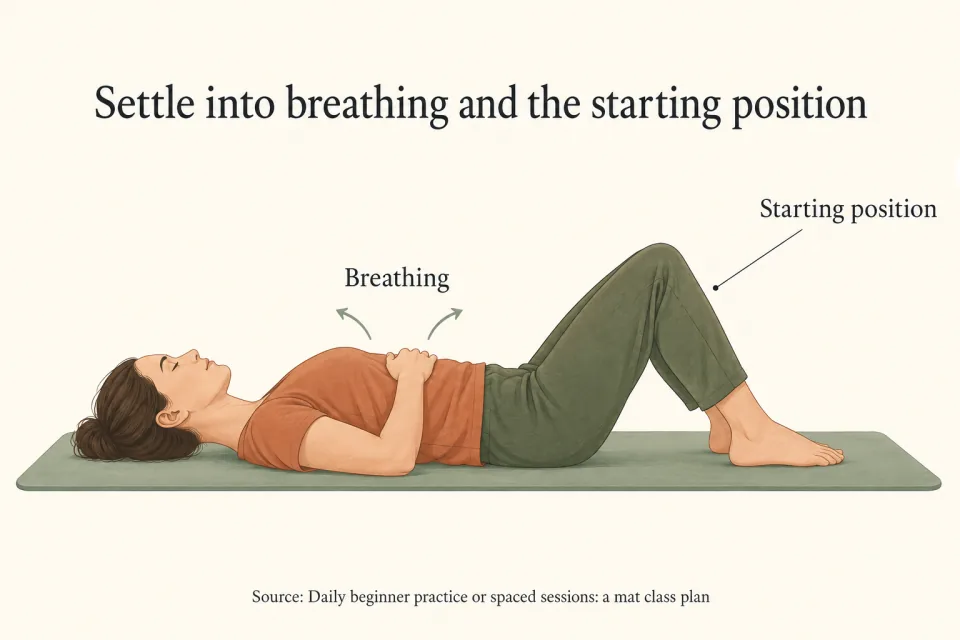
- Bring your attention to the breath before adding the movement shown by your instructor. Follow the breathing cue attached to the exercise, allowing the breath to continue as you change position. Avoid turning the preparation into a separate test of how long or deeply you can breathe.
- 09
- Begin with the starting position demonstrated in your chosen beginner session. Look at the placement of the hands and feet before following the moving part of the exercise. Take time to arrange yourself, then return your attention to the instructor rather than trying to remember the whole sequence at once.
- 10
- Draw in gently through the centre while allowing the rest of the movement to continue. Healthline describes this action as supple engagement rather than rigid bracing. Use that distinction as a cue for how you perform the exercise, without trying to hold your entire body motionless through every change of position.
- 11
- Soften your face and let your shoulders settle as you follow the next breath cue. Keep the movement at a pace that allows you to hear the instruction through to its end. Breath-holding, rushing and unnecessary tension are among the beginner technique mistakes described in Healthline's guide.
- 12
- Choose a particular principle to attend to during this part of the class, such as breathing or control. Mayo's introductory Pilates guide recommends learning the principles in a basics course and applying them throughout the exercises. For this session, make your chosen principle an observation you can describe afterwards: whether you followed the breathing cue, for example, or moved ahead of it.
- 13
- If you want a daily connection with practice, use this observation to define what that means on a day without a class. In an illustrative calendar, Tuesday might be reserved for reading your breathing note and reviewing a familiar instruction. Label that appointment as a technique review so that it remains distinct from Monday's completed class.
- 14
- Return to the starting position before continuing into the main matwork. Let the instructor supply the exercise name and its particular breathing pattern. Keep your own task small enough to follow clearly: establish the position, attend to the cue and then move.
Set 3 of 6
Follow the beginner matwork and reserve its full time
- 15
- Follow a complete beginner session for the main matwork, using the instructor's exercise names and transitions. The NHS beginner Pilates video lasts 45 minutes and requires no previous Pilates experience. Use that session as a concrete example when deciding whether a class fits the space available in your week.
- 16
- Set aside the video appointment before pressing play. Check whether the time you have reserved also accommodates getting ready and finishing the class. Keep any preparation or closing work you add visible in the calendar, rather than squeezing it into a slot already occupied by the guided session.
- 17
- For the Monday and Thursday example, attach the beginner video to each class appointment. Write the start and finish of the time you have available beside it. If the appointment does not fit, move it to a more workable part of the day instead of planning to rush the movements to meet the clock.
- 18
- For the Monday, Wednesday and Saturday example, check every appointment separately. A clear weekend slot does not establish that the weekday appointments are equally practical. Consider the time needed to begin, follow the instruction and close each class, then decide whether that arrangement belongs in your provisional calendar.
- 19
- Compare the calendars by looking at all the reserved class blocks across the week. Include the preparation and close attached to each block. Keep a separate note for the effort of the classes, so that a calendar showing more available time does not also imply that every session should be more demanding.
- 20
- Within the matwork, follow the movement at the demonstrated pace and attend to the position at its end. Pilates gives priority to the quality of the position over repetition count or energetic movement. Let the instructor's sequence determine when to move on, rather than repeating an exercise merely to occupy the remainder of an appointment.
- 21
- Use a pause in the recording when you need to look again at the demonstrated setup. Watch the relevant movement, arrange your position and then continue. The British Heart Foundation notes that recorded Pilates instruction cannot assess your movement or provide individual corrections.
- 22
- Put any unresolved question about the movement into your class notes for an instructor. Describe the part of the instruction you want explained, such as which part stays still during the movement. Keep the question tied to what you were asked to do, rather than judging the class by how closely its appearance matched the recording.
Set 4 of 6
Practise control and notice the effort
- 23
- Keep the instructed part of your body steady while moving the part named in the exercise. Begin with a smaller movement where that matches the instruction. Attend to the path of the movement and its return, rather than trying to make the movement larger before you can follow the sequence clearly.
- 24
- Follow the breath through the transition as well as through the main action. If you have been concentrating only on reaching the final position, bring your attention to how you arrive there. Let the return have the same deliberate pace as the outward movement instead of treating it as an unimportant reset.
- 25
- Use the next exercise to observe the effort of the class. The NHS distinguishes muscular effort from the time spent exercising and advises building up strength and flexibility work gradually. In your notes, keep the length of the appointment separate from your description of the work.
- 26
- Describe the session in ordinary terms once you reach a pause. You might record that the position was familiar, that the timing needed attention or that you wanted a break before continuing. These are prompts for your own observations, not expected responses or evidence that the class has produced a particular result.
- 27
- Consider those observations before placing another demanding class on the calendar. Better Health Channel's resistance-training guidance considers intensity, frequency, repetitions and rest separately. Use those categories as questions about the session: what you did, how much you repeated, how demanding it was and where the pauses occurred.
- 28
- Keep the scope of recovery guidance clear when planning. Better Health Channel advises approximately 48 hours before working the same muscle group again in resistance training. That recommendation concerns resistance training; do not use it as a fixed interval between every brief review of a Pilates breathing instruction.
- 29
- Look at other exercise already entered in the week before adding more Pilates. Healthline advises allowing recovery when Pilates and resistance training on consecutive days work the same muscles. For an illustrative calendar containing a demanding resistance session on Tuesday, reconsider Wednesday's proposed class rather than treating the activities as unrelated simply because their names differ.
- 30
- Finish this portion of the matwork with the exercise your instructor is guiding. Keep your attention on completing its movement and return. Leave the scheduling decision for the pause afterwards so that checking the calendar does not compete with following the exercise.
Set 5 of 6
Pause the matwork and review the daily option
- 31
- Pause after the guided matwork and record what you completed before choosing the next class day. Healthline suggests an exercise journal for tracking the muscles worked in a Pilates programme. Add the session name and your technique observations alongside that record so you can recognise what the appointment contained.
- 32
- Write down the time the class occupied in your day, including the preparation and close you used. Compare it with the appointment you originally reserved. If starting late meant you could not follow the planned session, adjust the calendar entry rather than describing the problem only as a lack of commitment.
- 33
- Now sketch an illustrative daily habit with different kinds of appointments. Keep Monday and Thursday as guided class days, use Tuesday for reviewing a breathing instruction and Friday for writing a question about technique. Leave Wednesday and the weekend for recovery, with any calendar check limited to reviewing the plan rather than adding another workout.
- 34
- Keep recovery entries visible. Better Health Channel's general exercise guidance recommends at least one recovery day each week, preferably two. A daily habit can include reading the plan or recording a completed class; those entries do not need to become exercise appointments to make the calendar look complete.
- 35
- Compare that arrangement with the spaced-class examples. If you prefer to finish a class and leave Pilates aside until the next appointment, use the spaced arrangement. If reviewing an instruction between classes appeals to you, include a review entry and describe exactly what you intend to look at.
- 36
- Check enjoyment alongside available time. Healthline's beginner advice includes assessing whether you enjoy Pilates and how you feel about the practice. Write your own response after the class, without borrowing a verdict from the schedule or assuming that a more crowded week must be more worthwhile.
- 37
- Choose the next appointment from the calendar that fits these notes. Keep the decision specific: retain the current spacing, move a class to a more workable day or replace a proposed class with a technique review. Avoid changing every part of the plan at once, so your next review can identify which scheduling choice you made.
- 38
- Return your attention to the mat for the close. Leave the calendar with a clear next appointment and a description of what that appointment is for. You can then finish this class without continuing to negotiate the whole week while moving.
Set 6 of 6
Close with a supported stretch
- 39
- Begin the close with the general floor stretches described by the NHS. These are closing exercise examples rather than named classical Pilates exercises. Keep their place in the plan clear so that the end of the class is included in the time you have set aside.
- 40
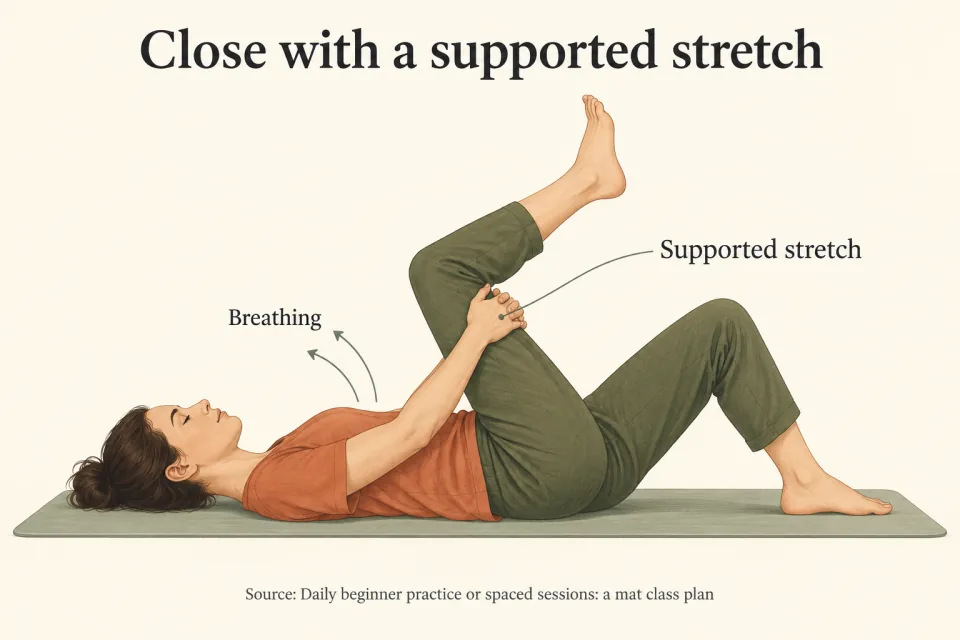
- For the lying hamstring stretch, leave the resting foot on the floor and raise the other leg. Support the raised leg below the knee. Settle into that arrangement before holding the position, rather than trying to combine the setup and the hold into a hurried movement.
- 41
- The NHS specifies a hold of 15 to 20 seconds for its hamstring stretch. Keep the support below the knee during the hold. Give the position its allotted time within the close instead of using this part of the class to catch up with the next appointment in your day.
- 42
- For the seated inner-thigh stretch, sit upright and bring the soles of your feet together. Gently lower your knees towards the floor. Let the upright sitting position remain part of the instruction as you settle into the stretch, rather than focusing only on where the knees finish.
- 43
- The NHS specifies a hold of 15 to 20 seconds for its inner-thigh stretch. Remain with the seated position through the hold, then finish the movement. Keep your attention on the stretch you are completing rather than beginning another exercise while watching the time.
- 44
- The NHS closing stretch routine takes approximately five minutes, with longer allowed when needed. Reserve the close as part of the class appointment. When you review the calendar afterwards, count this as time spent completing the session, alongside preparation and the guided matwork.
- 45
- Finish by noting the appointment you have chosen next. If it is a class, record the guided session you intend to follow; if it is a review, record the instruction you want to revisit. Let that specific plan answer whether daily attention to Pilates is useful for your week, while keeping the number of workouts a separate decision.