
Automated checks This plan went on the timetable after its content and sources passed the studio's automated checks on Sunday 1 November 2026. Before you start
Running order
Set 1 of 6
Warm up by noticing effort
- 01
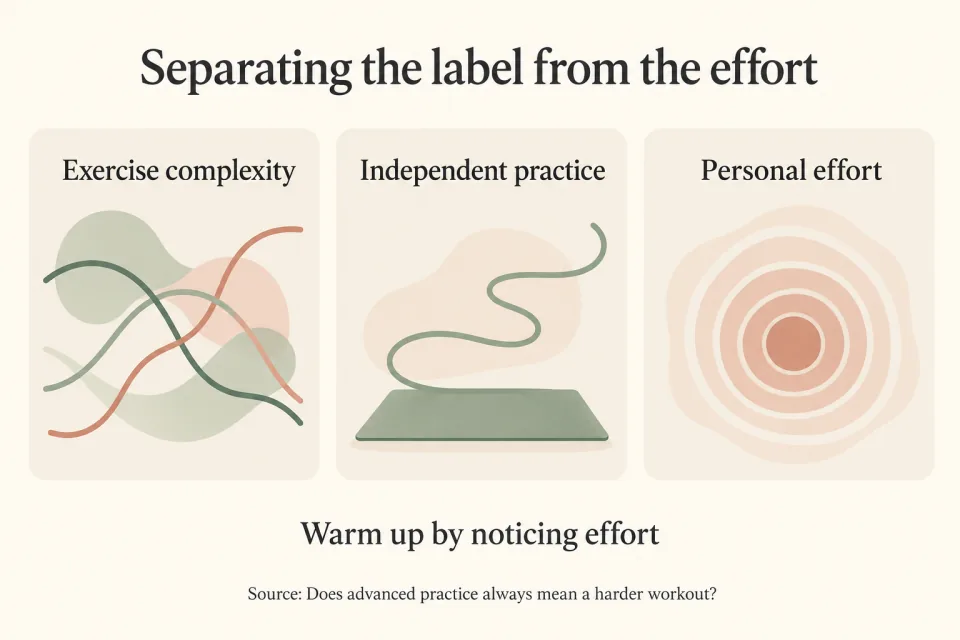
- Begin this mat class with familiar preparation, keeping exercise complexity, independence and personal effort separate in your attention. Read the advanced label as information about the practice, then consider the effort of the particular session.
- 02
- Settle into the preparation for Chest Lift that your teacher has shown you. Follow the breath before moving, and give yourself time to recall the starting position. Keep this opening preparation familiar so that you can attend to the distinction between knowing the movement and working through it.
- 03
- Notice how much effort you are using without assigning yourself a class level. The US CDC distinguishes effort relative to the person from the absolute intensity of an activity. Use that distinction as background for observing your session, rather than as a label for your ability.
- 04
- Keep any judgment about breathing separate from your judgment about coordination. The CDC's talk test concerns aerobic intensity, rather than knowledge of Pilates exercises or readiness for advanced repertoire. During this preparation, simply notice your usual breath and the instructions you are following.
- 05
- Bring your attention back to the starting position whenever you begin thinking about an advanced exercise you hope to learn. For this class, use the movement in front of you as the subject of observation. Ask yourself silently whether you are recalling a familiar action, following a fresh explanation or judging the effort of moving.
- 06
- Choose familiar preparation even if you usually attend a class with a more advanced label. The NHS beginner Pilates session includes people revisiting the basics as well as newcomers and improvers. Let that example inform your choice of class material without turning a beginner label into a judgment about the person practising.
- 07
- Prepare to move when you can recall the next cue. If you are following a recorded or taught session, use its explanation to establish the movement you will practise. Carry a simple question into the next set: which part of your attention belongs to the movement, and which belongs to how demanding it feels?
Set 2 of 6
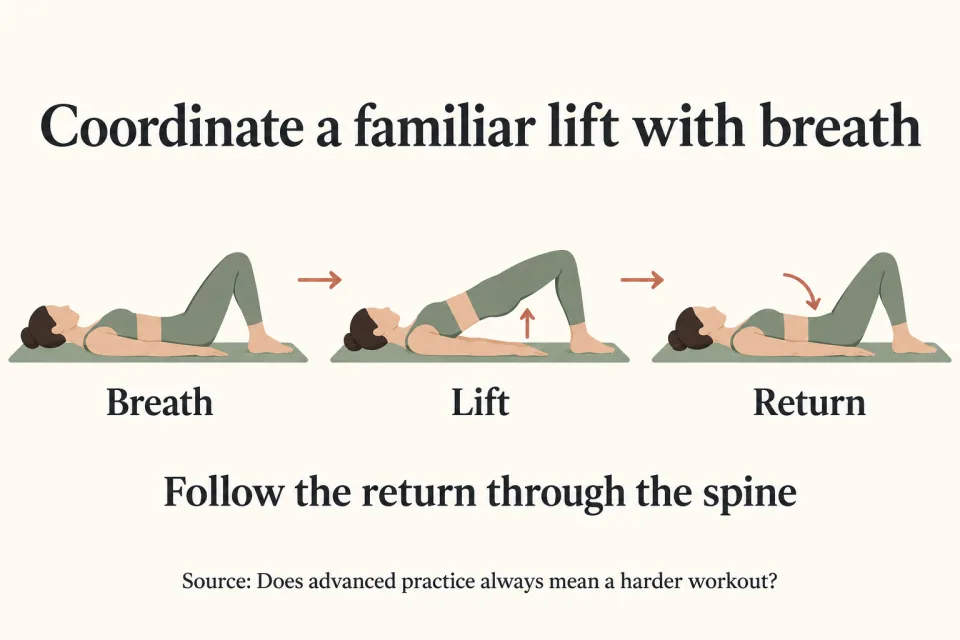
Coordinate a familiar lift with breath
- 08
- Practise Chest Lift with attention to the relationship between the movement and the breath. In the Frontiers in Physiology study, Chest Lift and Spine Stretch were classified as basic, while Roll Up and Double Leg Stretch were intermediate and Teaser and Jackknife were advanced.
- 09
- Prepare for Chest Lift using the version you have learned. Let the preparation have its own place in the exercise rather than moving immediately into the lift. Notice whether you remember that preparation without waiting for the next spoken instruction.
- 10
- Follow your teacher's cue for the trunk movement. The study's Chest Lift description connects preparation, movement, a maintained position and return with successive breaths. Attend to the phase you are performing instead of trying to think through the whole exercise while moving.
- 11
- Maintain the position for the breath assigned in your familiar version. Notice whether the instruction is clear to you, and distinguish that understanding from the effort of holding the position. Knowing what comes next and finding the present action demanding can be observations within the same exercise.
- 12
- Return with the breath specified by your teacher. Complete the return before directing your attention to another exercise. Use the end of the movement to notice whether you followed the whole sequence or mainly concentrated on reaching the lifted position.
- 13
- Recall the breathing sequence before another attempt. You can use the teacher's words as a prompt, then see which part you can remember without hearing it again. Keep the movement itself familiar while you examine how much explanation you use.
- 14
- Read the study's basic label alongside its movement description. For this exercise, the description includes a preparation, a lift, a maintained position and a return linked to breathing. Use those details to describe what you are practising instead of substituting the word easy for the word basic.
- 15
- Leave the exercise with separate descriptions of what you knew and what you felt. You might identify the breath sequence as familiar while describing the movement as demanding, or recognise that you needed another explanation before judging the effort. These are prompts for your own observation, not expected responses to the set.
Set 3 of 6
Follow the return through the spine
- 16
- Move into the Spine Stretch setup you already know, and make the return the focus of this set. Follow your teacher's preparation and outward movement before directing your attention to the order in which you come back.
- 17
- Return through the spine in sequence, travelling from the tailbone toward the head. Keep your attention on that order rather than on completing the return quickly. This is the sequence described for Spine Stretch in the Frontiers study.
- 18
- Finish the return before deciding whether the exercise felt straightforward. Consider the instruction you followed: perhaps the overall movement was familiar, while the order of the return needed closer attention. Use your own observation rather than assuming that a familiar exercise must feel a particular way.
- 19
- Separate the shape of the exercise from its organisation. In this set, your observation concerns how you follow the sequence through the spine. Avoid making the extent of the outward movement the only detail you remember when describing the exercise afterward.
- 20
- Follow the range of movement already established in your taught version. PD:Approval's qualification standards include range of movement, resistance, repetitions and rest among the variables used to programme a session. When comparing classes later, ask what changes within the exercises as well as which exercises appear.
- 21
- Notice the pace your teacher gives the return. The standards identify movement speed as a factor in posture, alignment and intensity. For this observation, keep the taught pace and consider it separately from the name or level of the exercise.
- 22
- Attend to any adaptation your teacher has already provided. The standards describe modifications such as adding support, replacing an exercise and shortening a lever. Record the actual version you practised in your memory, rather than treating the exercise name as a complete description of the set.
- 23
- Prepare to leave Spine Stretch by recalling the next starting position. Keep the return and the transition distinct in your attention: finish the movement, then follow the instruction for changing position. In the next set, carry forward the habit of describing the action itself before assigning it a difficulty label.
Set 4 of 6
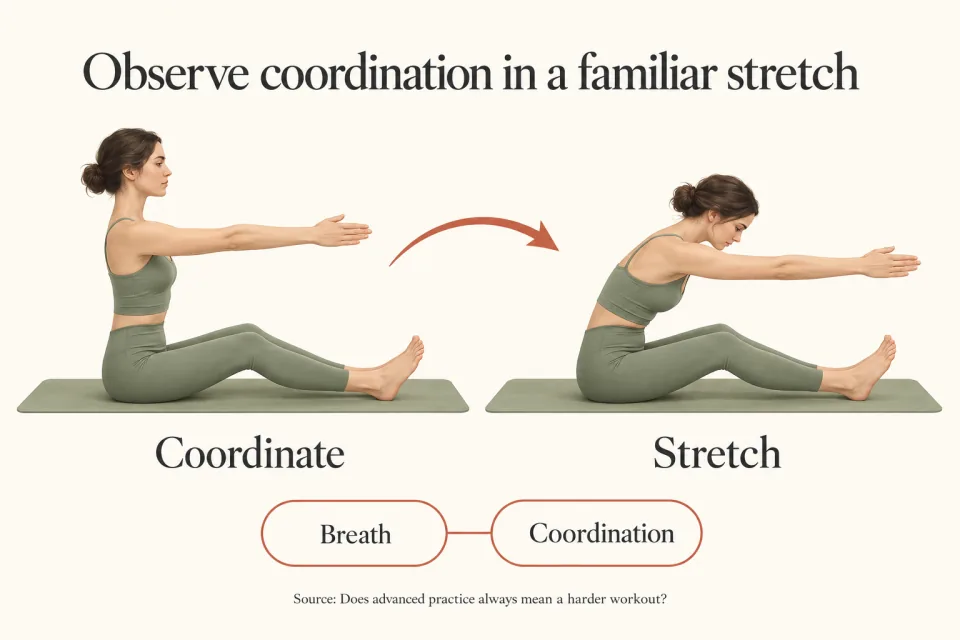
Observe coordination in a familiar stretch
- 24
- Use your familiar, taught version of Double Leg Stretch to attend to simultaneous movement. If this exercise is new to you, use this part of the class to follow a teacher's demonstration and identify its sequence.
- 25
- Watch the outward phase before trying to describe its difficulty. In the Frontiers study's version, the arms and legs extend together on an inhale, then return on an exhale. Notice the shared timing of the limbs and the breath rather than treating each action as a separate exercise.
- 26
- Follow that breath sequence within the version you have learned. Attend to the outward movement as it happens, then to the return. Keep your observation specific: whether the limbs moved together, whether you recalled the breath, and whether you needed a spoken prompt.
- 27
- Complete the return before reviewing the attempt. Describe any uncertainty in the instruction as uncertainty about the sequence, rather than immediately calling the whole exercise too hard. Then make a separate observation about the effort you experienced while moving.
- 28
- Consider Teaser through its description rather than adding it to this home sequence. The study describes Teaser as combining a V shape of the arms and legs with a controlled, sequential return through the spine. Compare the actions named in that description with the actions you have just followed in Double Leg Stretch.
- 29
- Keep the study's intermediate and advanced categories attached to its examples. When reading another class description, look for the exercise names and the expected versions as well as the level. Use the description to prepare a question for the teacher about what you would be expected to know.
- 30
- Observe any demonstration of an unfamiliar movement from beginning to end. Include the setup and return in your attention, rather than looking only at its most recognisable position. Ask the teacher to explain the route between positions if you do not understand how to move between them.
- 31
- Return to a familiar starting position for the next set. Retain a concrete description of this set's task: coordinating the outward movement with the inhale and the return with the exhale. Keep that description available alongside, rather than hidden inside, your judgment of how much effort the exercise required.
Set 5 of 6
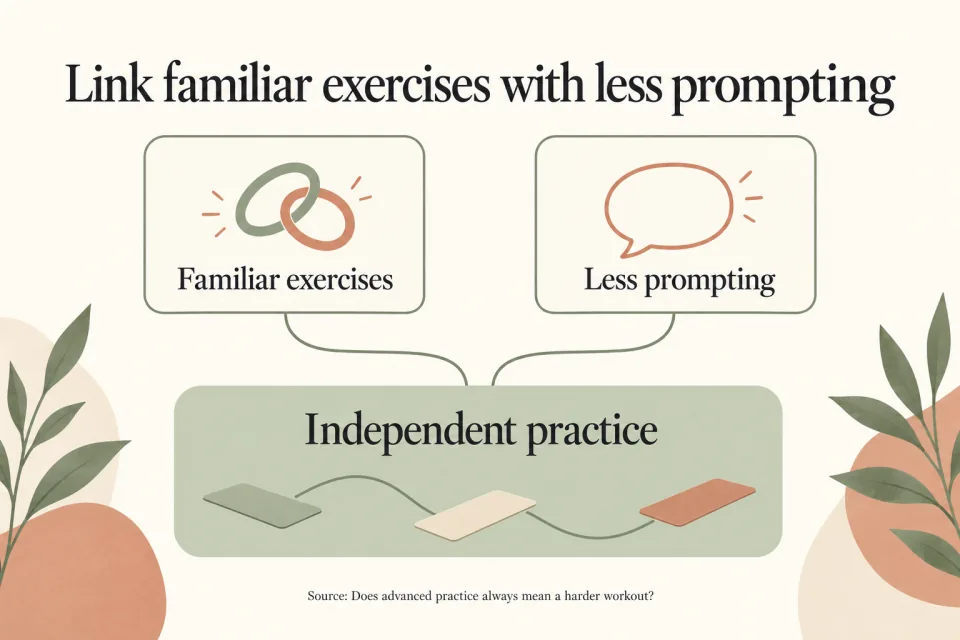
Link familiar exercises with less prompting
- 32
- Link familiar exercises in the order your teacher has given, paying attention to the transitions. PD:Approval describes flow in class objectives through linked exercises and the transitions between them.
- 33
- Finish each movement before following the route to the next setup. Notice whether you remember that route or wait for a demonstration. Keep the exercises familiar while observing how much of the sequence you can carry out from the teacher's existing instructions.
- 34
- Recall the next setup before the teacher repeats it, then check your understanding against the cue. The qualification standards expect mat instructors to support participants in performing exercises independently. Use independence here as something to observe in your practice, alongside the movement choices and your personal effort.
- 35
- Follow the class's existing pauses rather than changing them for this comparison. Pilates Association Australia explains that more complex choreography and greater continuity can make matwork challenging. When you describe the sequence afterward, include how it was linked as well as what it contained.
- 36
- Picture a comparison using the familiar movements from this class. In a teaching version, you could hear the setup explained before each exercise; in a more independent version, you could recall that setup from earlier instruction. This example changes the amount of prompting while keeping the exercise choices familiar.
- 37
- Distinguish that example from a change in continuity. A sequence with explanations between exercises and a sequence that links those exercises directly differ in how the class proceeds. When asking about an advanced session, ask about both the assumed knowledge and the way the movements are connected.
- 38
- Keep an apparatus label separate from your assessment of difficulty when comparing other classes. Pilates Association Australia explains that apparatus springs can assist an exercise or provide resistance. For a class on apparatus, ask what the spring setting does in the movement being taught rather than treating the setting alone as a difficulty score.
- 39
- Bring your attention back to the mat and finish the linked sequence. The association describes both matwork and apparatus practice as adaptable to the participant's ability. For your next class, ask which versions the teacher offers and how those versions fit into the shared sequence.
Set 6 of 6
Close by separating the label from the effort
- 40
- Close with the familiar Spine Stretch sequence, following the return through the spine as you did earlier. Let this final movement provide a clear endpoint for the class before you review its demands.
- 41
- Recall the effort of the session separately from the repertoire you practised. In the ACE-sponsored study, 15 women aged 18 to 26 with at least intermediate Pilates experience completed beginner and advanced mat routines. Keep that group and those particular routines in mind when interpreting the comparison.
- 42
- Compare the study's ratings without turning them into a target. Average perceived exertion during the workout portion was 14.2 for the beginner routine and 16.5 for the advanced routine on the study's six-to-twenty Borg scale. These figures describe the participants' ratings in that comparison.
- 43
- Keep the effort scales separate if you encounter them in other class material. The CDC describes relative aerobic effort on a zero-to-ten scale, whereas the ACE report used a six-to-twenty Borg scale. Read a rating with its scale rather than comparing the numbers alone.
- 44
- Review what changed in the study's advanced routine. It followed a similar session structure to the beginner routine but changed exercise positioning and pacing. Include those details when considering why a class label alone leaves part of the session undescribed.
- 45
- Describe your own class using the movement information you now have. Name the familiar exercises, recall where coordination needed attention, and note which setups you could follow independently. Then describe the effort separately, without using it as a verdict on your level.
- 46
- Read a prospective class description with those distinctions in mind. Ask the teacher about assumed exercise knowledge, demonstration time and transitions, then about pace, available modifications and opportunities to pause. These questions turn a broad level label into details you can compare with the session you have just practised.
- 47
- Finish by choosing what you want the next class to involve. You might want more explanation of an unfamiliar sequence, more practice recalling familiar setups, or a class whose pace you understand in advance. Use that preference to guide the conversation with the teacher instead of assuming that advanced always means a harder workout.
Reading list
- How to Measure Physical Activity Intensity
- Frequently Asked Questions: The Pilates Association Australia
- Diploma in Comprehensive Pilates Qualification Standards
- Comparisons of functional movements and core muscle activity in women according to Pilates proficiency
- ACE-sponsored Study: Can Pilates Do It All?
- Pilates video for beginners
From the studio's plan file
- Plan credited to
- UniPilates, with no writer named
- What backs it
- 6 sources in the reading list