
Automated checks This plan went on the timetable after its content and sources passed the studio's automated checks on Wednesday 4 November 2026. Before you start
Running order
- Warm up by naming the sequence you are learning
- Connect the opening exercises through their neighbours
- Rehearse omissions, additions and preparations separately
- Use face-down positions without merging separate passages
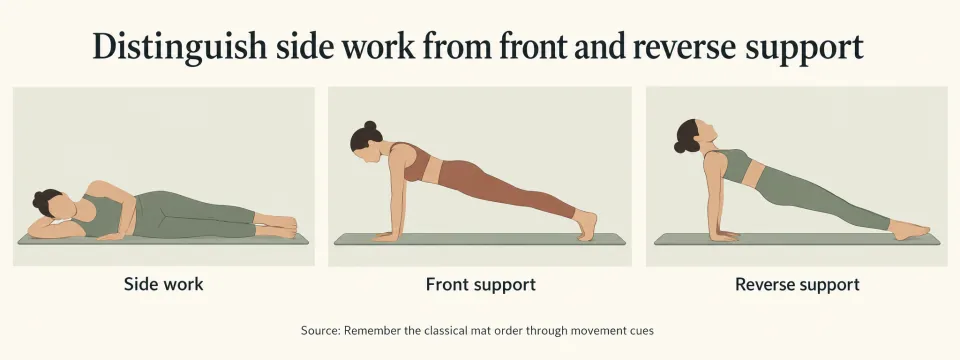
- Distinguish side work from front and reverse support
- Close with the standing return and a sequence check
Set 1 of 6
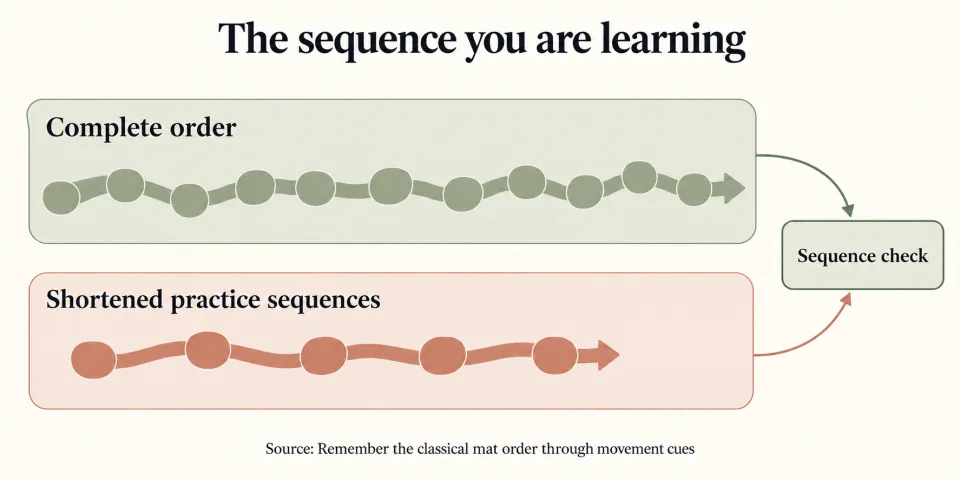
Warm up by naming the sequence you are learning
- 01
- This class rehearses the classical mat order through exercise families, body positions and the movement that comes next. Work through selected passages, keeping a shortened class distinct from a complete-order reference.
- 02
- Begin with a spoken warm-up: name the reference you are learning before naming its exercises. For this rehearsal, use Miki Kim's basic sequence as the opening passage, then examine selected additions and movement cues from the other references. The groups used here are memory prompts for this class.
- 03
- Keep the published repertoire separate from a teaching list. Rosemary Godfrey dates the publication of the classical sequence of 34 exercises to 1945. Say which reference you mean whenever you use the phrase complete order, so that your spoken rehearsal has a clear starting point.
- 04
- Read the length of your chosen teaching sequence alongside its name. Miki Kim's basic mat sequence contains 7 exercises, while her intermediate sequence contains 20 numbered exercises. Keep those labels attached to the sequences as you rehearse them, particularly when their routes separate and later meet again.
- 05
- Give the expanded reference its own label too. EQ Pilates presents 38 numbered entries in the sequence used for the author's practice and teaching. Use the reference name when checking an unfamiliar addition, rather than changing the sequence you were rehearsing midway through the exercise.
- 06
- Choose a consistent naming convention for your spoken practice. Follow the names printed in the reference in front of you, including labels such as Single Leg Circles or Side Kicks. When comparing references, place their labels beside each other before deciding how to say the passage aloud.
- 07
- Rehearse each passage with an exercise name followed by its next movement or position. Say the name clearly, then describe the connection in plain words. Use the movement descriptions supplied below where they apply, and keep a spoken rehearsal separate from performing the exercise itself.
- 08
- Set aside repetition counting during this memory warm-up. Work with the sequence of names and the connections between them; this class does not assign a repetition scheme. Carry the chosen reference into the next set so that every answer belongs to the same sequence.
Set 2 of 6
Connect the opening exercises through their neighbours
- 09
- Rehearse Kim's basic passage aloud: Hundred, Roll Up, Single Leg Circles, Rolling Like a Ball, Single Leg Stretch, Double Leg Stretch and Spine Stretch Forward. Keep that complete spoken passage available while you work on its smaller connections.
- 10
- Begin with Hundred and name Roll Up as its next neighbour in this sequence. Then start your recall at Roll Up instead of returning to the beginning. Give Single Leg Circles as the next movement, and check the answer against the same basic reference.
- 11
- Mark the direct connection from Roll Up to Single Leg Circles. Kim's basic sequence leaves out Roll Over at this point. When rehearsing the basic passage, say the direct connection; when comparing it with a longer reference, mark the omitted exercise separately rather than inserting it into the basic list.
- 12
- Link Single Leg Circles to Rolling Like a Ball, then link Rolling Like a Ball to Single Leg Stretch. Give each connection its own spoken cue. Keep the circular leg movement and the rolling exercise distinct in your wording, even though their names both suggest rounded movement.
- 13
- Use the shared wording in Single Leg Stretch and Double Leg Stretch as a local memory prompt. Say the names together, then attach Spine Stretch Forward to the end of that passage. Keep the prompt limited to these neighbours in Kim's basic sequence.
- 14
- Picture the described starting position of Double Leg Stretch: lying on the back with the head and legs lifted. Attach that position to the exercise name during your spoken rehearsal. Leave the arm pathway out of this particular cue so the task stays focused on identifying the exercise.
- 15
- Check the stretch passage in reverse as a recall exercise. Name Spine Stretch Forward, then say which exercise precedes it in the basic list; name Double Leg Stretch, then supply Single Leg Stretch. Reverse only the spoken questions, while keeping the movement order unchanged.
- 16
- Finish this set by beginning your recitation at Rolling Like a Ball. Continue through the remaining basic exercises without adding an intermediate movement. Then return to Hundred and recite the whole basic passage, keeping the direct Roll Up connection and the closing Spine Stretch Forward clear.
Set 3 of 6
Rehearse omissions, additions and preparations separately
- 17
- Open this set at Double Leg Stretch and follow Kim's intermediate route through Single Straight Leg Stretch, Double Straight Leg Stretch and Criss Cross to Spine Stretch Forward. Keep this passage beside the shorter basic route you have just rehearsed.
- 18
- Practise the branch by naming the reference before giving the next exercise. After Double Leg Stretch in Kim's basic sequence, answer Spine Stretch Forward. At the same point in her intermediate sequence, answer Single Straight Leg Stretch, then continue through the added passage before reaching Spine Stretch Forward.
- 19
- Carry the intermediate passage beyond that meeting point. After Spine Stretch Forward, rehearse Open Leg Rocker, Cork Screw and Saw. Attach Saw to the end of this group, then start again at Open Leg Rocker so you can recall the passage without reciting the earlier exercises.
- 20
- Keep similar exercise names distinct when comparing the lists. Limitless Pilates identifies Single Straight Leg Stretch as an addition outside the original classical exercises. Retain the word Straight when saying its name, and use the full label when checking its place in Kim's intermediate sequence.
- 21
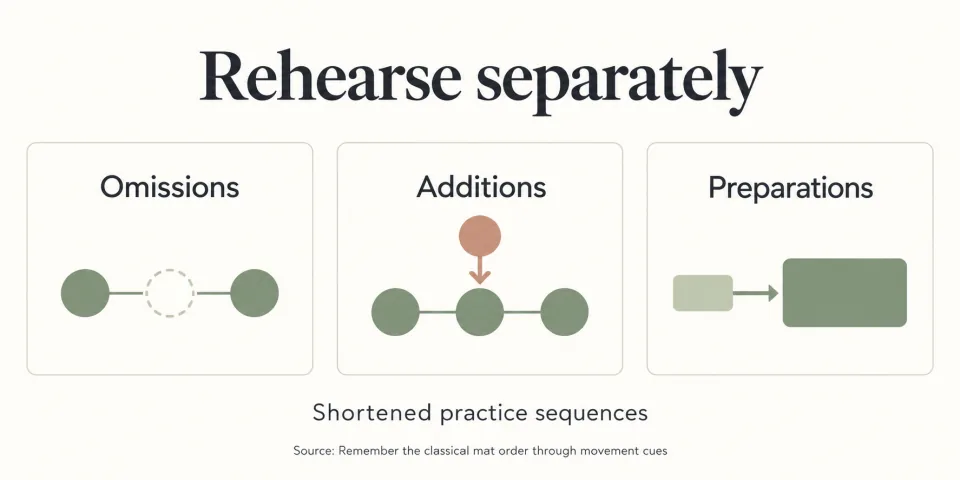
- Mark an omission by showing the connection that remains. Use Kim's basic Roll Up to Single Leg Circles passage as your example, with Roll Over written separately as the omitted movement. Read the shortened passage as printed instead of leaving a spoken blank where the omitted exercise would sit.
- 22
- Mark a preparation beside the exercise it prepares for. Godfrey's shortened practice includes Roll Over preparation and Open Leg Rocker preparation, as well as Double Toe Taps. Keep the word preparation in your rehearsal rather than silently replacing it with the name of the full exercise.
- 23
- Mark an addition at its stated location. EQ Pilates places Thigh Stretch between Double Leg Kick and Neck Pull. Rehearse that local passage with the reference named, then compare it with Kim's intermediate passage, where Double Leg Kick leads to Neck Pull without that entry.
- 24
- Close the comparison by giving a different instruction for each change. For an omission, connect the remaining neighbours; for a preparation, retain its preparation label; for an addition, name its neighbours in the relevant teaching list. Use these distinctions when checking a shortened class against a longer reference.
Set 4 of 6
Use face-down positions without merging separate passages
- 25
- Rehearse Kim's intermediate passage from Saw through Neck Roll, Single Leg Kick and Double Leg Kick to Neck Pull. Keep the exercise names in that order while you examine the face-down movement cues in this set.
- 26
- Place the Swan-Dive description beside this passage as a separate reference. Limitless Pilates describes the classical starting position with the body lying on the stomach and the arms alongside it. Picture that starting shape when recalling Swan-Dive, without substituting its name for Kim's Neck Roll entry.
- 27
- Keep the Swan preparation label audible when that is the version being discussed. The Limitless Pilates page describes a progression through a small Swan preparation, Swan, Swan catch and continuous rocking. Follow those version labels in your rehearsal instead of using the final movement name for every stage.
- 28
- Picture One Leg Kick with the body lying on the stomach and the upper body supported on the elbows. Use the bent knee as the moving part of the picture, then imagine the working leg straightening before the other leg takes its turn. Keep this cue attached to the exercise description.
- 29
- Give Swimming a different face-down picture. Extend the arms overhead in your mental rehearsal, then pair the right arm with the left leg and the left arm with the right leg. Keep the torso quiet in the picture while the opposite limbs alternate.
- 30
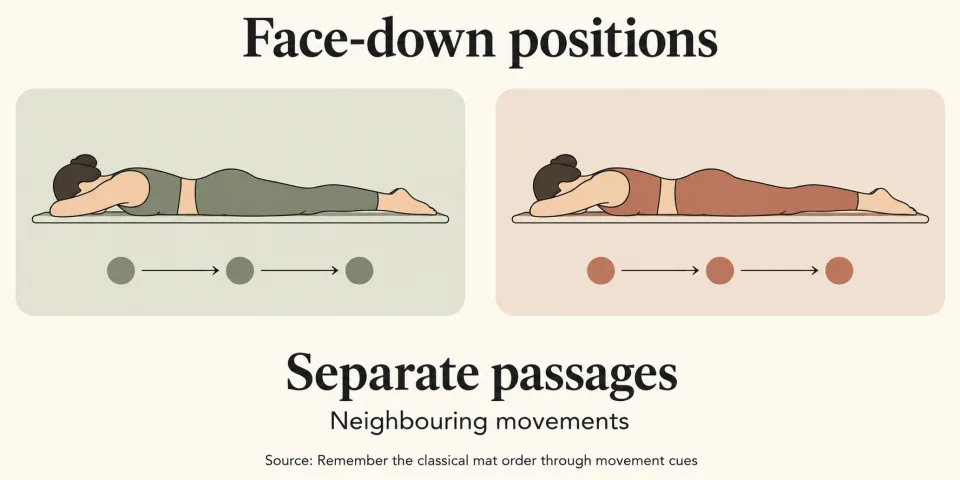
- Separate the shared position from the place in the sequence. Rehearse One Leg Kick and Swimming as different movement descriptions, then return each name to the passage you are learning. Do not make them neighbours merely because both descriptions begin with the body facing the mat.
- 31
- Use Mo Wolfe's transition example to recall Swimming within the passage she discusses. After the sequence containing Teaser, Can-Can and Hip Circles, picture rolling down and turning onto the stomach. Attach the turn to Swimming, keeping the preceding names tied to Wolfe's example.
- 32
- Finish by matching the name to the arm position. Recall arms alongside the body for the described classical Swan-Dive start, elbow support for One Leg Kick, and arms overhead for Swimming. Say the exercise name after its position, then return to your chosen order before continuing.
Set 5 of 6
Distinguish side work from front and reverse support
- 33
- Rehearse Side Kick through its side-lying position, then study the contrasting support positions of Leg Pull-Front and Leg Pull. Treat these as selected memory examples, keeping their locations attached to the reference you are following.
- 34
- Picture Side Kick lying on the side with the head and upper body supported in the chosen version. The Limitless Pilates description offers either a bent bottom knee or a straight bottom leg. Keep that supporting-leg choice separate from the movement made by the upper leg.
- 35
- Name the moving-leg variation before picturing it. Use front-and-back kicks, circles, bicycle movements or upward lifts from the Side Kick page, and retain the Side Kick name while describing the variation. Avoid turning each variation into an assumed separate place in the order.
- 36
- Check how the teaching list groups that work. Kim places front-and-back kicks, up-and-down kicks and circles within the same Side Kicks entry. When reciting her sequence, use Side Kicks at that place; expand the variation names only when rehearsing the contents of the entry.
- 37
- Move your attention to the support position of Leg Pull-Front. Picture hands and feet on the mat, the body facing down, and wrists beneath shoulders. Use that orientation as the prompt attached to the name, especially when checking a reference whose labels differ from yours.
- 38
- Follow the described leg action within that position. Picture the pelvis staying in line with the shoulders and ankles as a leg lifts, then return the foot to the plank position before changing sides. Let the return to support complete the cue before naming the next action.
- 39
- Give Leg Pull its separate starting picture: seated with straight legs and the hands behind the pelvis. Follow the pelvis upward into line with the shoulders and ankles. Keep the hands-behind position in your recall cue so it remains distinct from the face-down start of Leg Pull-Front.
- 40
- Picture the Leg Pull leg action with the pelvis staying lifted as a foot rises, then change legs. The same source also describes reverse support without the leg kick. If rehearsing that version, retain the modification in your wording rather than adding the kick to the mental picture.
- 41
- Close this set by saying the exercise name before describing its support. For Side Kick, give side lying; for Leg Pull-Front, give face-down support on hands and feet; for Leg Pull, begin with the seated, hands-behind setup. Check those pictures against the names before returning to the sequence.
Set 6 of 6
Close with the standing return and a sequence check
- 42
- Use the described Push Up pathway as the closing movement picture for this rehearsal. Begin standing, follow the roll-down, and picture the hands walking forward until the body reaches plank.
- 43
- Continue the picture through the lowering phase with the elbows close to the sides. Keep this movement attached to the Push Up name rather than ending your recollection at the hand walkout. Give the lowering phase its place within the exercise before moving to the return.
- 44
- Follow the hands back toward the feet after the push-up phase, then picture the spine rolling back up to standing. Finish the movement description at standing. Keep the whole pathway together when you say Push Up, including the approach to the mat and the return from it.
- 45
- Now rehearse the ending of Kim's intermediate sequence separately. After Neck Pull, say Side Kicks, Teaser and Seal. Stop the spoken sequence at Seal when checking that reference, keeping this teaching-list ending distinct from the Push Up movement used to close the present rehearsal.
- 46
- Check a sequence from an interior starting point. Begin at Spine Stretch Forward in Kim's intermediate list and continue through Open Leg Rocker, Cork Screw and Saw. Then begin at Neck Pull and give its remaining passage, without supplying exercises from another reference.
- 47
- Check the branch after Double Leg Stretch again, this time naming the route before speaking it. Give the direct connection to Spine Stretch Forward for the basic list, or the passage through the straight-leg stretches and Criss Cross for the intermediate list. Keep the reference name in the answer.
- 48
- Check a movement from its position rather than its previous exercise. Picture the arms overhead while lying face down and name Swimming; picture the seated, hands-behind start and name Leg Pull. Return each answer to its own reference instead of assembling a new order from these position prompts.
- 49
- End by reciting the chosen practice sequence with its own omissions, preparations and additions intact. When a connection is missing, reopen the reference at that connection and rehearse the neighbouring names. Close the class with the sequence you intended to learn, clearly labelled and complete on its own terms.
Reading list
- Transitions are the Glue
- Basic Exercise Order in Classical Pilates
- Intermediate Exercise Order in Classical Pilates
- Classical Mat Order
- Classical mat: the first fifteen exercises
- 12. The Swan-Dive
- 13. The One Leg Kick
- 24. Swimming
- 25. The Leg Pull-Front
- 26. The Leg Pull
- 21. The Side Kick
- 34. The Push Up
- 7. The Double Leg Stretch
From the studio's plan file
- Plan credited to
- UniPilates, with no writer named
- What backs it
- 13 sources in the reading list